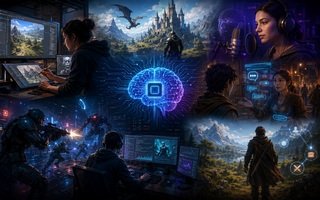
How AI Is Changing Games? Just a few years ago, artificial intelligence in games was mostly associated with simple bots or predictable enemies following scripted patterns. Today, everything is changing. AI has become one of the most important technologies in the gaming industry, and many developers already see it as the future of gaming.
The impact goes far beyond gameplay itself. Artificial intelligence now helps artists, writers, programmers, designers, and testers. Players are beginning to notice AI everywhere — in NPC behavior, quest generation, animations, voice acting, and even dynamic world events.
Most importantly, AI makes games feel more alive. Worlds become less predictable, characters behave more naturally, and adventures feel more personal for every player.
In this article, we will explore how AI is already changing modern games, what players can expect in the future, and why this technology may completely transform gaming as we know it.
Smarter NPCs
One of the most noticeable changes involves NPCs — non-playable characters.
In older games, NPCs usually followed extremely simple behavior patterns. Merchants stood in one place forever, guards walked in circles, and enemies attacked using predictable scripts. After a few hours, players could easily understand how everything worked.
Modern AI is changing that.
Today, NPCs can:
- react to player behavior;
- remember past interactions;
- adapt to different situations;
- change tactics;
- interact with each other;
- create a stronger sense of realism.
This is especially important in RPGs and MMORPGs. Some modern projects are already experimenting with AI-powered NPCs capable of holding natural conversations without relying entirely on pre-written dialogue.
Imagine entering a tavern in an MMORPG where the innkeeper actually responds to your questions, comments on world events, and reacts to your reputation. That no longer sounds impossible.
AI makes characters feel less robotic and much more immersive.
AI-Generated Game Worlds
Another massive area where AI is making an impact is content generation.
Developing large games requires enormous amounts of time and money. Huge maps, thousands of objects, quests, animations, dialogue systems, and environmental details are expensive to create manually.
AI helps speed up this process.
Today, artificial intelligence can already:
- generate landscapes;
- create textures;
- assist with level design;
- compose music;
- generate dialogue;
- create voice lines;
- help design quests.
This is especially valuable for indie developers. Small teams now have access to tools that were once available only to major AAA studios.
A single developer can potentially create projects that previously required dozens of people.
Of course, AI is not fully replacing human creativity. But it dramatically reduces repetitive work and accelerates production.
Personalized Gaming Experiences
One of the most exciting aspects of AI is personalization.
In the past, most players experienced games in roughly the same way. Different classes or factions existed, but the overall structure remained similar.
AI is gradually changing this.
Future games may:
- analyze player behavior;
- adjust difficulty dynamically;
- alter storylines;
- generate unique events;
- adapt enemy tactics;
- create personalized quests.
For example, players who enjoy exploration may receive more hidden areas and puzzle-focused content, while competitive players could encounter more PvP-oriented challenges.
Games may eventually become unique experiences tailored to every individual player.
This could be revolutionary for MMORPGs, where AI-driven systems may create dynamic server-wide events instead of repetitive daily quests.
AI and Animation
Animations are one of the most expensive parts of game development.
Traditionally, many movements had to be created manually by animators. This process required huge amounts of time and effort.
AI is beginning to assist here as well.
Modern systems can:
- generate in-between animations automatically;
- improve facial expressions;
- adapt character movement;
- create more realistic reactions;
- smooth transitions between actions.
As a result, characters feel more natural and believable.
This is particularly important for open-world games and MMORPGs filled with hundreds of active NPCs.
AI in Game Testing
Game testing is an incredibly difficult and time-consuming process.
Developers need to find bugs, balance systems, test quests, and check countless gameplay scenarios.
AI can automate part of this work.
For example:
- bots can simulate thousands of gameplay sessions;
- AI can identify bugs faster;
- systems can analyze problem areas;
- developers receive detailed behavioral statistics.
This helps studios release more stable games.
Human testers are still essential, but AI is already becoming a powerful tool for quality assurance.
Artificial Intelligence in PvP
AI is also influencing competitive gaming.
Modern multiplayer games use AI for:
- cheat detection;
- toxic behavior analysis;
- matchmaking improvements;
- player training systems;
- advanced practice bots.
Cheat detection is especially important. AI can analyze suspicious behavior much faster than traditional systems.
Meanwhile, training bots are becoming increasingly advanced and capable of imitating real player behavior, helping newcomers improve without frustration.
MMORPGs and AI: A Perfect Combination
For MMORPGs, AI could become a true revolution.
One of the biggest problems in many MMOs is repetitive content. After several months, players often notice the same patterns:
- repetitive quests;
- predictable NPCs;
- static world events;
- identical dialogue systems.
AI has the potential to solve these issues.
Imagine an MMORPG where:
- NPCs remember players;
- cities evolve naturally;
- factions wage dynamic wars;
- economies change in real time;
- quests are generated dynamically;
- the world reacts to player actions.
This could make MMORPGs feel far more alive than ever before.
Many developers are already experimenting with similar systems, and the industry is clearly moving in this direction.
AI and Voice Acting
Until recently, full voice acting was available mainly in large AAA games.
Today, AI-powered voice generation is becoming more advanced and affordable.
Modern speech synthesis technologies allow:
- more natural voices;
- dynamic dialogue generation;
- easier localization;
- faster content updates.
This is especially useful for live-service games and MMORPGs that constantly add new content.
However, AI voice generation is also controversial. Many voice actors worry that AI could eventually replace parts of their profession.
As a result, debates about AI-generated voices are growing across the gaming industry.
AI Could Transform Storytelling
Story-driven games are also evolving thanks to artificial intelligence.
Traditionally, dialogue systems are written entirely by hand. AI opens the possibility of generating dynamic responses in real time.
This could allow:
- deeper conversations;
- unique NPC reactions;
- non-linear storytelling;
- realistic interactions.
In the future, players may literally talk to NPCs as if they were real people.
That could completely transform the RPG genre.
Concerns About AI in Gaming
Despite its advantages, many players remain cautious about AI.
Several major concerns appear frequently.
Loss of Creativity
Some gamers worry that AI-generated content may feel less original.
Players value artistic vision, handcrafted worlds, and unique developer creativity. If studios rely too heavily on AI, games may start feeling too similar.
Job Losses
Another concern is the potential reduction of jobs in the gaming industry.
If AI handles work traditionally done by:
- artists;
- testers;
- writers;
- localizers;
- animators,
studios may reduce staff sizes.
This has already become a major discussion topic within the industry.
Low-Quality Content
AI can generate huge amounts of content very quickly. However, fast production does not always guarantee quality.
There is a risk of seeing more low-effort games created mainly for profit.
Why AI Will Still Shape the Future of Gaming
Despite the concerns, the growth of AI in gaming is impossible to stop.
The gaming industry has always evolved alongside technology:
- graphics improved;
- physics systems advanced;
- online gaming expanded;
- open worlds became larger;
- animations became more realistic.
AI is simply the next major step.
Most likely, the best future games will not be created entirely by AI. Instead, developers will use artificial intelligence as a powerful tool to support creativity and build richer worlds faster.
Human creativity will still remain at the center of game design.
What Players Can Expect Next
Over the next several years, AI will become increasingly visible in games.
Players may soon experience:
- fully dynamic NPCs;
- unique quests;
- personalized storylines;
- living MMORPG worlds;
- smarter enemies;
- adaptive world events;
- realistic conversations;
- better animations.
Many of these technologies are already being tested today.
Within the next 5–10 years, games may look completely different from what we know now.
Conclusion
Artificial intelligence is no longer just an experimental technology. It is rapidly becoming a core part of the gaming industry.
AI is changing:
- game development;
- NPC behavior;
- animations;
- storytelling;
- PvP systems;
- MMORPG design;
- content generation;
- player interaction.
For ordinary gamers, this means one thing: games are becoming more alive, dynamic, and unpredictable.
There are still debates surrounding AI, and concerns about creativity and jobs remain important. However, one thing is certain — artificial intelligence has already begun transforming gaming, and this process will only continue to accelerate.
The future of gaming is getting closer, and AI will play one of its biggest roles.