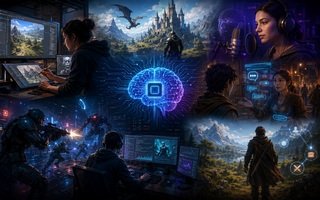
AI NPCs are gradually moving beyond impressive technology demos. In 2026, developers are already working with game characters that can do more than generate dialogue. They can remember previous events, pursue goals, interact with other characters and continue existing inside a virtual world even when the player is no longer there.
A few years ago, most AI NPC experiments were relatively simple. A player could speak to a character, and a language model would generate a response instead of using a traditional dialogue tree. Today, the technology is moving toward something much more ambitious: NPCs that behave like autonomous agents inside a living game world.
From Dialogue to Autonomous Behavior
Modern AI NPCs combine several technologies. A language model can handle conversation and decision-making, memory systems allow characters to retain information about previous events, while game AI connects those decisions to the actual world.
This means an NPC can have its own goals and constraints and choose what to do next. A character might go to work, meet another resident, change its opinion of that person, learn something new and later use that information during another interaction.
That is a much more interesting concept than simply putting a chatbot inside a game.
One of the most notable examples in 2026 is SEED, developed by Klang Games. The project is a social MMO simulation that deliberately moves away from the traditional NPC model. Instead of filling the world with decorative characters, SEED focuses on Seedlings — virtual inhabitants living inside a persistent world.
Klang Games describes SEED as a simulation of society in which players influence communities rather than simply controlling a single hero. The project entered Early Access in July 2026, bringing the concept closer to an actual game rather than a technology demonstration.
Thousands of Characters Could Become Independent Agents
The most exciting part of this trend is scale.
It is one thing to run a sophisticated AI model for a single virtual companion. It is something completely different to build a world containing thousands of autonomous characters.
Every character potentially needs to understand its current state, surroundings, objectives and relationships with other characters. That requires a very different technical architecture from traditional scripted NPC systems.
This is where smaller, specialized models and local inference become increasingly important.
NVIDIA ACE, for example, provides technologies designed to create autonomous game characters capable of perceiving their surroundings, planning actions and interacting with players. NVIDIA emphasizes small models optimized for gaming hardware and low-latency inference.
ACE is already being used across several types of game characters, from AI teammates in PUBG to Smart Zois in inZOI and adaptive enemies. In inZOI, Smart Zois can plan actions and reflect on their decisions, making them considerably more advanced than traditional NPCs following a fixed set of scripted behaviors.
What Happens When the Player Logs Off?
This could become the biggest change AI brings to game design.
Imagine leaving a virtual city for several in-game days and returning to discover that a shopkeeper has fallen out with another resident, prices have changed, a character has moved to another neighborhood and a new social group has appeared.
Traditional games usually rely on carefully scripted events that happen after the player completes a specific quest or reaches a certain point in the story.
SEED is built around a very different idea. Klang Games is developing a persistent simulation in which characters continue to exist and develop independently of direct player control.
The philosophy is changing from creating a world for the player to creating a world that exists alongside the player.
The Technology Still Has Serious Problems
However, it would be too early to say that AI NPCs have completely solved the problem.
One major challenge is computational cost. Thousands of characters making decisions continuously could require enormous amounts of processing power. Developers therefore need smaller models, efficient memory systems, decision hierarchies and different levels of simulation depending on how important an NPC is at a given moment.
There is also the problem of AI-generated dialogue itself.
SEED provides a useful example. While the concept is impressive, 2026 coverage of the Early Access version pointed out that AI characters can still produce awkward conversations, vague responses and dialogue that sometimes makes the world feel less believable rather than more immersive.
This shows that an AI NPC is much more than a language model connected to a character.
A convincing character needs memory, personality, goals, limitations, context and a clear understanding of the game’s rules.
The Next Step Is an Artificial Society
That is why 2026 may become an important year for AI in games.
The conversation is gradually moving beyond making NPC dialogue sound more natural. The next goal is to create systems containing many autonomous agents that interact with each other and generate events that developers did not explicitly script.
If developers can solve the problems of computational cost and behavioral reliability, games could gain an entirely new form of content.
Instead of thousands of characters with thousands of pre-written lines, developers could create thousands of characters with their own memories, motivations and relationships.
The developer would establish the rules of the world — and the AI NPCs would help create what happens inside it.
That may ultimately be the most important change. The future of game characters may not simply be about NPCs learning to talk like people.
It could be about NPCs learning to live as part of a virtual society.